
Why your hens need balance — not just big numbers
It’s a common assumption: the higher the protein on the bag, the better the feed.
But when it comes to poultry nutrition, that’s not quite how it works.
A feed with 18% or 20% protein might look impressive on paper — but what really matters is how much of that protein your birds can actually use.
And that comes down to the amino acid profile, not the raw number.
What hens need — and what they don’t
Laying hens rely on protein to build muscle, produce feathers, and lay eggs. But just as with our bodies, the chicken’s body doesn’t use “protein” in bulk — it uses amino acids.
Think of these as the building blocks of protein, each with a specific role.
– Lysine and methionine, for example, are essential for egg production and feather integrity
– A shortfall in these, even with high total protein, can limit performance
– Excess protein, on the other hand, can lead to unnecessary nitrogen waste and place strain on the bird’s metabolism.
More isn’t better — better is better.
Why Egg Booster uses an “Optimum Amino Acid Profile”
Our Egg Booster Layer Pellet contains 16% protein.
Our animal nutritionist has determined this is the ideal number for laying hens.
It is formulated not to be the highest on shelf, but the most balanced.
Rather than chasing a raw protein number, we focus on:
- Targeting the ideal digestible amino acid levels
- Matching energy and mineral availability
- Using clean, certified organic grain that’s more readily absorbed
- Avoiding overload — which can lead to wet litter, heat stress, or inefficiencies.
The result? A feed that performs in real-world backyard settings.
Birds lay well, stay in condition, and avoid the side effects of overfeeding protein.
What to watch for with high-protein feeds
Some high-protein feeds are built for birds under intensive production, or for fast-growing meat breeds.
In a mixed or home-scale flock, they can be too rich, and this leads to:
- Excess nitrogen in droppings
- Heat stress, especially in warmer months
- Imbalanced calcium–phosphorus ratios
- Overconsumption of energy to process unnecessary nutrients.
If you’re feeding kitchen scraps or allowing hens to forage, a clean 16% feed with the right amino acid profile offers everything your birds need, without tipping the balance.
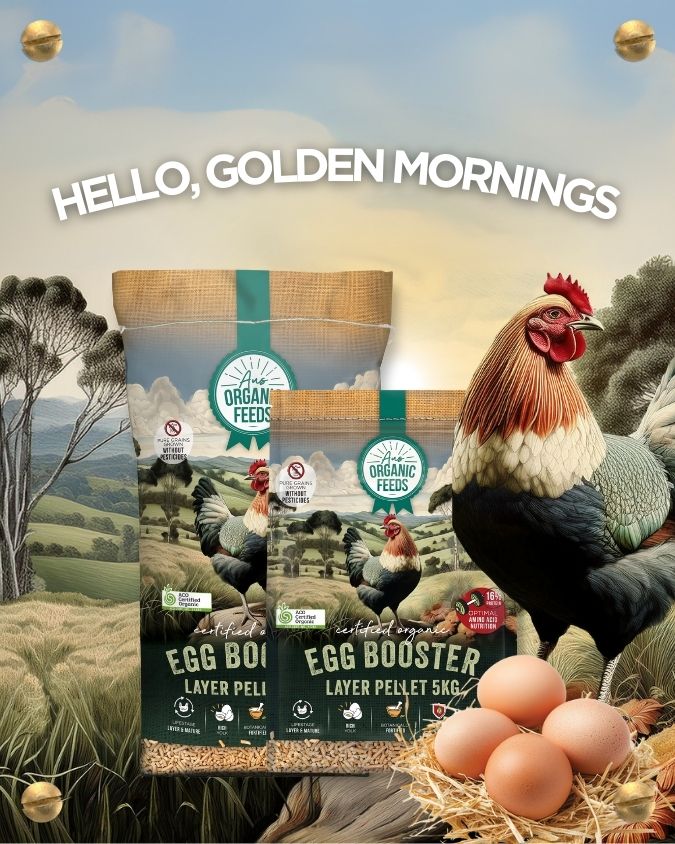
Aus Organic Feeds Egg Booster Layer Pellet is not only certified organic, and thus free of nasty pesticide residues. It’s also designed for healthy laying and complete digestibility — with an optimum amino acid profile, not inflated protein claims.